
As we go through culture shock, there are different ways that we can adapt to the host culture. A famous model that explains this is Berry’s Acculturation Model also known as Berry’s Strategies of Acculturation, demonstrated in Figure 1-1 below.
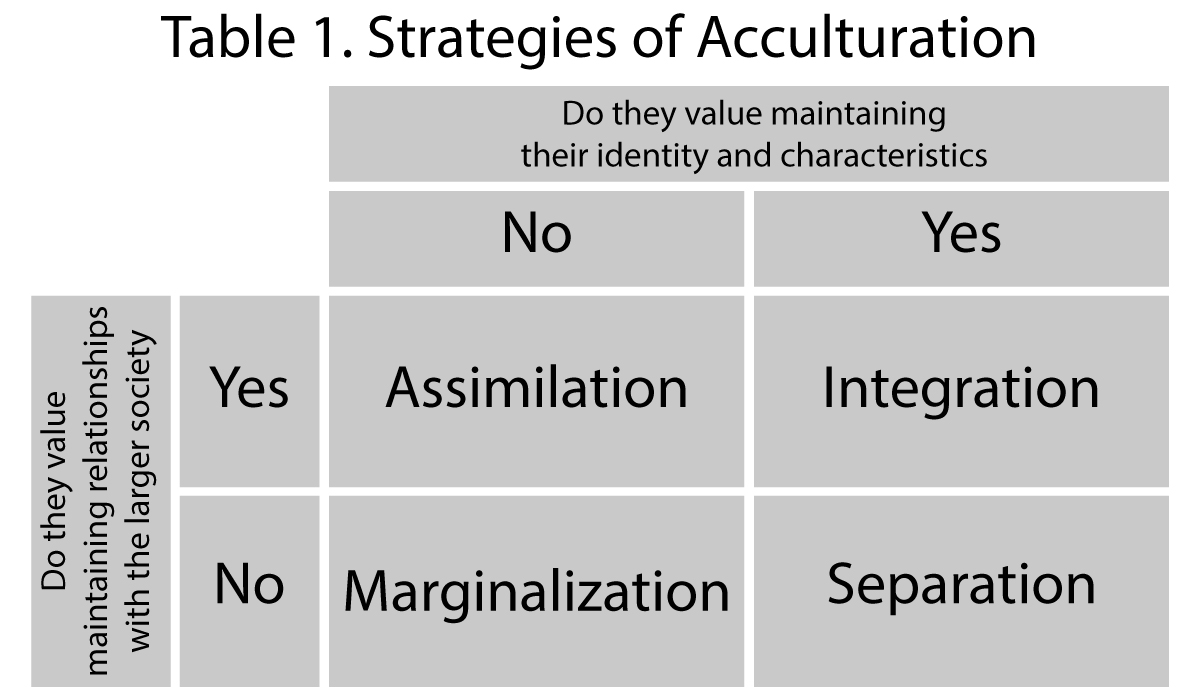
As you can see, there are 4 possible outcomes to how a person will adapt to a new society. Keep in mind that people are different and everybody’s personal experiences will be uniquely different, but many expats will end up experiencing something very close to one of these four outcomes.
The Four Outcomes
Assimilation is when you let go of your home’s cultural perspectives, behaviors, ideologies, and habits, and you slowly start to replace them with the host culture’s counterparts as you feel more closely connected to and comfortable with the new culture’s way of doing things. Integration is when you retain your cultural identity, but add the necessary “new” cultural expected nuances of the host culture you are in. You switch between the expected cultural behaviors depending on who you are interacting with and what the situation requires. Separation is when you keep adhering to your original home culture and you do not accept the new host culture. This is when at stage 3 culture shock you do not start adapting or accepting the new host culture that you are in. Marginalization is when you do not adapt, accept, or adhere to the host culture, but also you stray away and alienate yourself from your home culture. You find that aspects of your own culture and the new one don’t align with your personal goals, ideologies, or perspectives. It is important to remember that these four outcomes are not solely under the control of the person entering a new culture. They can also be strongly influenced by the attitudes, beliefs, and laws of the host cultures. Acculturation is a two-way street, and both the newcomer and host culture play a role in which of the four outcomes will occur.
- Look again at the four outcomes. Which are positive? Which are negative?
- What kind of things could affect these outcomes?
- Which outcome or outcomes do you think are most likely for expats?
- What about expats in your culture? Which outcome would be the most likely?
Factors Affecting Culture Shock

There are five key factors affecting how an expatriate will experience and overcome culture shock.

- Training. This is extremely important in increasing the success rate of overseas workers integrating into their new societies. Preparing expatriates for culture shock ahead of time and setting their expectations reduces the effects of culture shock and helps workers move through the stages more easily. There are many types of training and not all organizations train expats in the same way, but those that take the time to prepare their employees for long periods of time in new cultures can reduce the failure rate of their workers.

- Demographic characteristics of the expatriate and his or her family. Another extremely important factor to consider, if an expat is not single, is his or her family dynamic. Even if an expat adjusts to the host culture, that does not mean that their spouse or children will. Spouses can feel culture shock strongly as they may have given up their jobs, home, and social network to go to the new culture. For children, the large and profound changes of moving to a new country and leaving behind friends, school, and family can be extremely difficult. Young children in general adjust easier than older children, but it isn't easy for any child. The love and support of a family can help ease culture shock for expats, but it can also exacerbate it.

- Personality traits of the expatriate. Research has shown that there are certain personality traits that make people better suited to handling culture shock. Some of these traits are,
- Cultural Flexibility: This simply means people who are culturally open-minded, i.e. they are more willing to accept new ideas and norms and change their own perspectives. Many people believe this to be vital when going through acculturation.
- Ethnocentricity: As we mentioned before, ethnocentricity is the belief that your own culture is superior to others. It would make sense that people who have low ethnocentricity would be better able to adjust to culture shock. People with strong feelings of ethnocentricity may not be culturally flexible enough to succeed in a new culture.
- How you handle stress: This can be a good indicator of an expat’s ability to overcome culture shock and uncertainty. Obviously, those who handle stress well, calmly, and with generally positive outcomes have a better chance than someone who does not.
- Interpersonal skills: The ability to have interpersonal relationships that meet the cultural expectations of a society you are in is important. Even if you have good interpersonal skills within your own culture, that does not mean that you will be the same in a host culture. This is why training is important. Those that learn how to navigate relationships in the new culture are much more likely to thrive there.

- Organizational support given to the expatriate: This has a huge impact on the success of expats overcoming culture shock. Pre-departure training is important of course, but we are also talking about support in the host country. For example; Organizations that help expats set up bank accounts, access services, find accommodation, and enroll their kids in school significantly reduce the uncertainty and cultural stress their employees feel. The more support an organization gives to its employees, the higher the chance they will be able to move through the stages of culture shock.

- The technical competence of the expatriate: A common and costly mistake that many organizations make is choosing candidates for foreign assignments based purely on their technical abilities. Wanting to have the best technically qualified candidate is understandable, but it will mean nothing if the candidate fails to assimilate or integrate into the host society. Previous international experience has also been shown to reduce culture shock, so workers who have that experience may succeed at higher rates.
Group Discussion: “When asked about the main causes of assignment failure, poor candidate selection was mentioned by 84% of companies participating in the GMAC GRS-NFTC-SHRM Global survey (2001). Adjustment failure costs well above $150,000 (U.S.) per person (Briscoe, 1995), in addition to an estimated cost of $80,000 for training, relocation, and compensation.”
- Think about your personality traits. Do you think you would be a successful expat?