Welcome to the iTEP Academic Preparation course! This first lesson is designed to demystify the iTEP Academic-Plus exam. Our goal is to give you a clear understanding of the test's structure and purpose. By knowing exactly what to expect, you can build a strong strategy and face the exam with confidence. Let's begin by thinking about our own skills.
Opening Discussion
As a warm-up, let's consider our personal strengths and weaknesses. Take a moment to think about this question: Which English skill—Reading, Listening, Speaking, Writing, or Grammar—do you feel most confident about for an academic test? Which do you feel least confident about? Be prepared to share your thoughts. There are no right or wrong answers; this is about self-assessment.
Strategy Focus: Proficiency and Intelligence
Success on an exam like the iTEP depends on two key things. The first is language proficiency—your actual ability to understand and use English. This is what you've been building for years. The second is test-taking intelligence. This means understanding the test's format, managing your time effectively, and knowing how to approach each type of question. This course is designed to build both. Think of it like this: being a great driver (proficiency) is essential, but you also need to know the specific layout of the racetrack (test intelligence) to win the race.
What is the iTEP Academic-Plus?
The iTEP (International Test of English Proficiency) is used by colleges, universities, and organizations around the world to measure the English skills of applicants. The "Academic-Plus" version is specifically for those planning to study in a higher education environment. This video provides an excellent overview of what to expect on test day.
iTEP Test-Day Experience
An overview of what to expect when taking the iTEP exam.
The Language of Testing
To prepare effectively, we need to understand the language used to talk about the test itself. These are our key terms.
| Word | Definition | Example |
|---|---|---|
| assessment | (noun) the process of evaluating or measuring someone's abilities or knowledge. | The iTEP is an assessment of your academic English skills. |
| multiple-choice | (adjective) a type of question that offers several possible answers from which you must choose the correct one. | The Grammar section consists entirely of multiple-choice questions. |
| proficiency | (noun) a high degree of skill or expertise in something. | The exam measures your proficiency in five core areas. |
| prompt | (noun) a set of instructions or a question for a writing or speaking task. | The writing prompt asked me to discuss the advantages of renewable energy. |
| rubric | (noun) a set of guidelines or rules used to evaluate a performance, like a speaking or writing response. | The speaking section is scored using a detailed rubric that assesses fluency, grammar, and vocabulary. |
| score report | (noun) an official document that shows your results on a test. | Your iTEP score report will show an overall score and individual scores for each section. |
| section | (noun) a distinct part or division of the test. | The Listening section is divided into two parts. |
| timing | (noun) the management of the time allowed for a test or a section of it. | Proper timing is crucial to ensure you complete all the questions. |
An Overview of the iTEP Sections
The iTEP Academic-Plus exam is approximately 90 minutes long and is delivered online. It has five sections, plus a short unscored sample at the beginning. Understanding the structure is the first step toward success.
Reading (20 minutes)
This section assesses your ability to understand academic texts. It has two parts:
- Part 1: A short passage (around 250 words) followed by 4 multiple-choice questions.
- Part 2: A longer passage (around 450 words) followed by 6 multiple-choice questions.
Listening (20 minutes)
This section measures your comprehension of spoken English in academic contexts. It has three parts:
- Part 1: Four short conversations followed by 1 multiple-choice question each.
- Part 2: One 2-3 minute conversation followed by 4 multiple-choice questions.
- Part 3: One 4-minute lecture followed by 6 multiple-choice questions.
Grammar (Structure) (10 minutes)
This section tests your knowledge of English sentence structure and grammar. It features 25 multiple-choice questions, where you must identify an error or choose the correct word/phrase to complete a sentence.
Writing (25 minutes)
This section evaluates your ability to express ideas in written English. It has two parts:
- Part 1 (5 minutes): You will read a short paragraph on a topic and then be asked to write a short response (50-75 words) giving your opinion.
- Part 2 (20 minutes): You will read or listen to a brief prompt on a more complex topic and must write a well-organized essay (175-225 words) expressing and supporting your opinion.
Speaking (5 minutes)
This section assesses your ability to speak clearly and coherently on academic topics. It has two parts:
- Part 1: You will hear and read a short question, then have 30 seconds to prepare and 45 seconds to speak.
- Part 2: You will listen to a short presentation on a topic (e.g., from a university course), then have 45 seconds to prepare and 60 seconds to speak, summarizing and giving your opinion on the information.
Group Activity
In groups, review the breakdown of the five sections. Discuss the following: Which section or specific part do you think will be the most challenging for you? Why? What about it seems difficult? Share your thoughts with your group members.
Understanding Your Score
The iTEP provides a comprehensive score report that is easy to understand. You will receive an overall score on a scale from 0 (Beginner) to 6 (Advanced), as well as individual scores for each of the five sections. This detailed feedback helps you and your institution understand your exact strengths and areas for improvement.
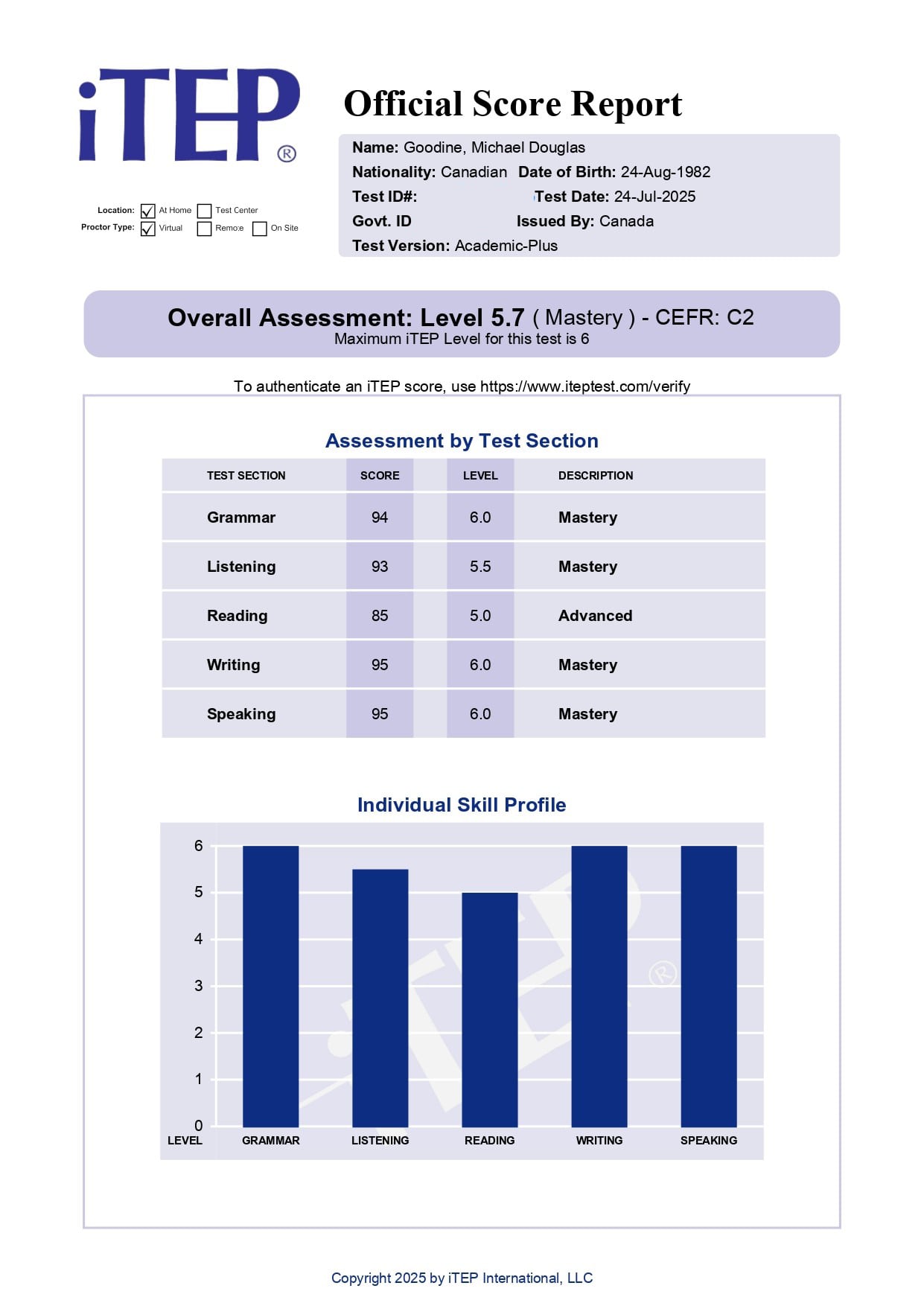
Sample iTEP Score Report
The report shows an overall level plus individual scores for each section.
Your Path Forward
At the end of this introductory unit, you will take a diagnostic test. The purpose of this test is not to give you a final grade, but to establish a baseline score. A baseline score is a starting point. It helps us see where you are right now so we can create a personalized plan to help you reach your goal. It's the first step on your journey to success.
Remember, preparation is key. Understanding the test format is just as important as knowing the language. By the end of this course, you will be prepared for both the content and the structure of the iTEP exam.