In this lesson, you will learn how to understand official air quality advisories and turn them into simple, clear actions for different people. We will practice using modals for giving advice and the first conditional to talk about what to do in different situations.

Warm-up

Think about the last time you experienced smoke or haze from wildfires or pollution. What did you do? In pairs or small groups, discuss the question: "My smoke/haze plan right now is..."

Do you have a clear plan? Is it based on official advice? Share your ideas with your group.

Decode the Guidance

When air quality is poor, governments issue public health guidance. This advice helps people protect themselves, but it can sometimes be long or confusing. Our job is to find the most important information.

First, let's understand the key tool: The Air Quality Index, or AQI.

That Air Quality Index Number, What Does It Mean for You?

Watch this video to learn more about the AQI and what the different levels mean for your health.

Video Transcript

With wildfire smoke and fine particulate matter filling our air on an increasingly regular basis, you may be wondering at what air quality index level you should be staying indoors, keeping children from playing outside, closing your windows, or looking into an air purifier. Well, the answer to all of these questions is that since everybody's different and unique, we can't really say one size fits all or one number fits all. [ 00:00:28 ]

Generally, a one is clean and no need to have concerns. Over 10 means everyone should take precautions. However, every number in between is not cut and dry. Every little bit of an increase in air pollution leads to an increased risk. [ 00:00:42 ]

As it's going up, how are we feeling? If you do feel throat irritation, coughing, or your eyes are running, that's the beauty of the inflammatory response. It's a quick response of our body to fix damage or to attack invading microbes. [ 00:01:00 ]

In this case, with wildfire smoke, a normal healthy adult may just need to be more aware and monitor those symptoms when the air quality levels are moderate, from 5 to 6. For a vulnerable person, as defined by the air quality health index, at level five, we would basically say you should be considering stopping what you do outside, in particular anything strenuous, and moving it indoors or postponing it until the level is below four. [ 00:01:30 ]

If it's 10 plus, we say you should be inside and should not be outside. That's the vulnerable population. [ 00:01:36 ]

But what is the point when the average adult should actually stay indoors? Levels between 8 to 9 would make sense to make shifts in how much you are exposed. Poor air quality could be a trigger or exacerbate many health conditions. [ 00:01:50 ]

The same goes for children and healthy seniors. Think more of a 7 to 8 on the index as a good place to start making some alternate indoor plans. [ 00:01:59 ]
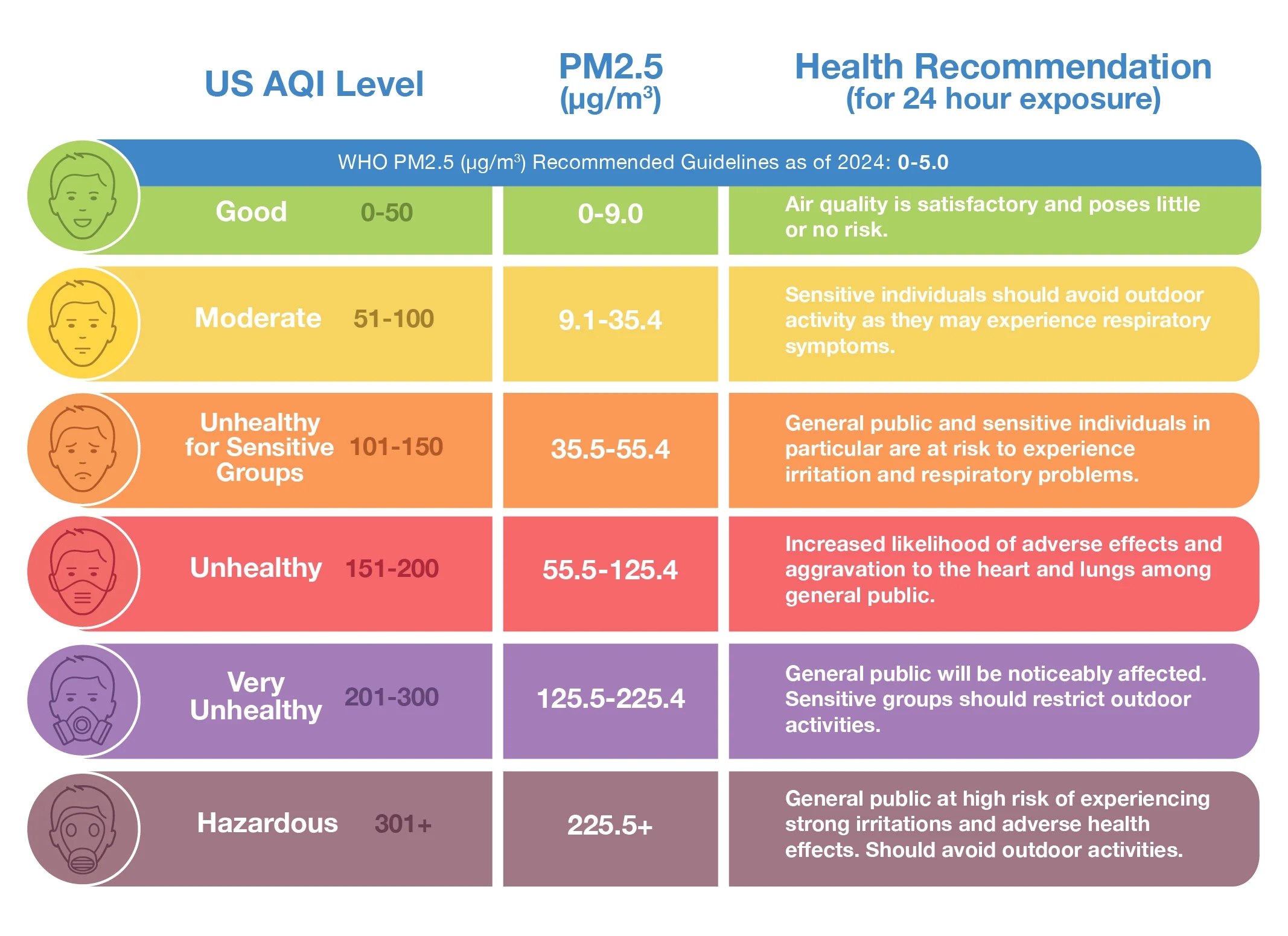
An infographic showing the Air Quality Index scale from Green (Good) to Maroon (Hazardous).

This scale helps us quickly understand the level of pollution in the air. The higher the number, the greater the health risk.

Now, read this summary of official guidance from the U.S. Environmental Protection Agency (EPA) for when the AQI is in the Orange (Unhealthy for Sensitive Groups) to Red (Unhealthy) range.

Official Guidance: Responding to Wildfire Smoke

When air quality is unhealthy, everyone may begin to experience some adverse health effects, and members of sensitive groups may experience more serious effects. Sensitive groups include children, older adults, pregnant people, and people with heart or lung disease, like asthma.

Recommendations:

  • Reduce your exposure. Stay indoors as much as possible with windows and doors closed. If you have an air conditioner, run it in recirculation mode to keep smoke out.
  • Use air purifiers. Consider using a high-efficiency particulate air (HEPA) filter or a DIY air cleaner to create a "clean room" in your home. This is especially important for sensitive individuals.
  • Limit strenuous activity. Avoid heavy outdoor work or exercise. The more active you are, the more pollution you breathe in.
  • Wear a respirator mask. If you must be outdoors, wear a well-fitting N95 or P100 respirator. Simple dust masks or cloth masks do not provide enough protection from fine particles in smoke.
  • Pay attention to symptoms. If you experience coughing, difficulty breathing, or dizziness, move to a cleaner space and seek medical advice if symptoms persist.
  • Stay informed. Check your local air quality forecast regularly on websites like AirNow.gov.

Group Task

Work in triads. Your teacher will assign each person in your group one of the following personas. Read the guidance above and pull out the three most important steps for your assigned person.

A young child using an asthma inhaler.

Persona 1: A Parent

You have a 7-year-old child with asthma. Your child is part of a sensitive group and is very vulnerable to air pollution.

A construction worker wearing a hard hat and safety vest outdoors.

Persona 2: An Outdoor Worker

You work in construction. Your job requires physical labor outside for 8 hours a day. Staying home isn't an option.

An older adult walking on a path in a green park.

Persona 3: An Older Adult

You are 70 years old and live alone. You enjoy a daily walk in your neighborhood park.

Discuss in your triad: Why are these three steps the most critical for your persona?

Rewrite the Message

Official guidance is useful, but sometimes we need to make the message simpler and more direct. To do this, we can use specific grammar for giving strong advice and explaining consequences.

Language Focus: Modals for Advice

We use modal verbs to give advice or make recommendations. They have different levels of strength.

  • Should: This is the most common way to give advice. It's a strong recommendation.

You should stay indoors when the air quality is poor.

  • Ought to: This is similar to 'should' but is more formal and less common in speaking.

We ought to check the AQI forecast every morning.

  • Had better ('d better): This is stronger than 'should' and implies a negative consequence if the advice is not followed. It's often used for urgent situations.

You'd better wear an N95 mask outside, or you might have trouble breathing.

Language Focus: First Conditional for Contingencies

We use the first conditional to talk about the result of a possible future action. It helps explain why the advice is important.

Structure: If + present simple, ... will + base verb. (Or other modals like 'can', 'may', 'might').

If-clause (Condition) Main clause (Result)
If you exercise outside when there's smoke, you will breathe in more pollution.
If you close the windows, you can keep the indoor air cleaner.
If the AQI goes above 150, sensitive groups should take extra precautions.

Your Task

Now, use this language to transform the official guidance for your persona.

  1. Create a Public Service Announcement (PSA). Write one clear, powerful sentence (120 characters max) giving the most important advice for your persona. Use should, ought to, or 'd better.
  2. Create a 3-Step Action Plan. Write three clear, simple steps for your persona. Use the first conditional in at least one step to explain the consequence or benefit.

Think-Pair-Share: Share your PSA and action plan with your triad. Give each other feedback. Is the message clear? Is the advice practical?

Role-play: Community Briefing

It's time to share your advice with the community.

Instructions

  1. One person from your triad will be the "Community Health Advisor."
  2. The advisor will join a new group of students (the "Community Group").
  3. The advisor has 45 seconds to present their 3-step action plan for their persona (e.g., "Today, I'm here to talk about protecting older adults from wildfire smoke...").
  4. After the briefing, the community group members will ask "what if..." questions. The advisor must answer them using the first conditional.

Example Questions from the Community:

  • question_mark What if I don't have an air conditioner or HEPA filter?
  • question_mark What if my job requires me to be outside?
  • question_mark What if my child has a soccer game scheduled?
  • question_mark What if I feel fine even though the AQI is high?

The goal is to practice giving clear advice and explaining consequences under pressure. After a few minutes, rotate speakers.

Exit Ticket

Reflect on what you've learned today. In your notebook or quietly to yourself, answer this question:

What is one action you will actually take to prepare for or respond to a poor air quality day in the future?

Exercise

keyboard_arrow_up